Showing posts with label Film. Show all posts

Saturday, 15 August 2015

Independence and Partition - I: Azaadi aur Garam Hawa

After watching Masaan for a second time last weekend, I realised, while discussing the film with a friend, that one of the big gaps in my cultural upbringing is the fact that I somehow missed seeing M.S.Sathyu's Garam Hawa, perhaps because I was too young when it was released (1974) and later, I was away from India for nearly two decades. A story in last weekend's edition of Hindustan Times informed me that the film was available on Youtube. So I promptly decided to to see it, and now realise why so many regard it to be one of the great films of Indian cinema.
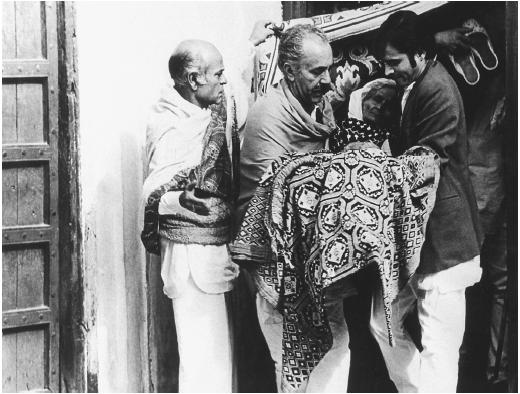


Appropriately, I finished watching it yesterday, August 14, just in between the anniversary of Pakistan's and India's Independence Day celebrations (in fact, the two days are actually the same when you consult the Indian Independence Act of 1947: Karachi's The Dawn had a fine piece the other day on the theme: http://www.dawn.com/news/1199235)

The film is altogether too chilling, too real for our bubbled lives of 2015. It begins with a scene whereby Salim Mirza (the immortal Balraj Sahni) has just bid goodbye to his elder sister, who has caught the one-way train to Pakistan. On the way to his factory, he remarks to the taanga-waallah:

"कैसे हरे-भरे दरख़्त कट रहे हैं इस हवा में!" 

("Such leafy, green trees are being felled by this wind these days!")

And the taanga-waallah responds with workmanlike gusto:

"बड़ी गर्म हवा है मियाँ, बड़ी गर्म!" 

("It is a very hot wind, very hot!")

Every moment of the next two hours, the viewer is kept on the edge of the seat, as one tragic scene after another unfolds with premonitory perfection.

What a film! The movie breaks your heart​ again and again, and yet again​, but ends on a note of redemptive hope, howsoever meagre.​ It should be watched compulsorily, especially by our young people in schools and colleges: 

https://www.youtube.com/watch?v=QZTvF_1AN8A​


This 2014 interview ​that Teesta Setalvad (who says she has seen the film 27 or 28 times!) does with MS Sathyu and Shama Zaidi, ​the film-maker/scriptwriter​,​ on the making and re-release of Garam Hawa (as Garm Hava) is worth watching too: 

https://www.youtube.com/watch?v=bEGhKn4LhzA


The cruel absurdity of Partition was understood even by the man invited to draw the line between the two birth-marked Sub-Continental twins. Cyril Radcliffe "never forgave himself. He was summoned to Delhi in 1947 — he was neither an administrator nor a cartographer, but only a lawyer, who had never set foot in India before — with the specific assignment of partitioning Punjab and Bengal on religious lines. He arrived on July 8 that year, and having done his job, left India the very day it attained Independence, burning all his papers and without collecting his fee, 40,000 rupees — so appalled he was by the killings." Over a million people were killed and at least 12 million were rendered homeless to serve the political ambitions of our wicked leaders. Gandhiji was virtually alone in his mourning.

There are farmers, both on the Indo-Pak and on the Indo-Bangladesh borders, whose home falls in one country and their fields in another. There are neighbours' adjoining courtyards through which the Radcliffe Line runs!:

Before we are Hindus and Muslims, we are human beings, equal in the eyes of the one and only Creator. Not only was this borne out once when a Hindu bigot had to unknowingly accept a Muslim man's blood for his bleeding child in hospital, there is also evidence aplenty in our traditions of art, literature, and music. Yesterday's edition of The Hindu had a splendid piece which reports the influence that the great Ustad Amir Khan has had on a very large number of musicians in succeeding generations, including on the likes of Vidushi Kishori Amonkar, and Pandit Ulhas Kashalkar:

http://www.thehindu.com/features/friday-review/ustad-and-the-world-of-gharanas/article7535908.ece


If Indian and Pakistani leaders in 2015 have any courage left in their hearts whatsoever, they will never allow 1947 to repeat itself. Partition is the massive, unacknowledged gaping wound in our history. Even before it had begun to heal, more pogroms were launched, more wars fought. The pathology has only grown. The denial has become cancerous now. It shall prove truly fatal, unless the facts and passions are faced through mutual acknowledgement of very inconvenient truths. We urgently need memorials, museums, histories, films, literature, art, and, above all, a Truth and Reconciliation Commission, howsoever belated that may be. 

One reason to study and acknowledge history collectively, in the public sphere, is to prevent it from repeating itself farcically, once communities have grown accustomed to the gravity of the original tragedy and have all but forgotten its spiritual, emotional, and physical impact when the bloodstains had not dried up.



Saturday, 8 August 2015

Salman ko Salaam !


“Kyonki tu Dhad-kan…main dil!”

When Munni and Pawan made me weep


Today is August 9, 2015. Exactly seven decades have passed since Washington committed perhaps the greatest war crime in the history of man by testing a plutonium bomb on the Japanese city of Nagasaki, close on the heels (just three days) after testing a uranium weapon on Hiroshima’s innocents. I say “testing” because such weapons were new to our species and it was yet to be known precisely what their destructive potential was. These two tests in real time helped zero in on the right numbers (for that time. The remarkable thing is that we still do not know exactly how many - obviously non-White - innocents were butchered in this dual savagery. Estimates vary between 130,000 and 250,000). 

Equally importantly, “Little Boy” and “Fat Man”, as the twin bombs affectionately came to be referred to by the Allied military establishment, also enabled the Untidy State of America to supersede the rising Soviet Union and define the contours of the remainder of the century (by controlling the terms of the Cold War and its hundreds of hot proxies in the “Third” World), if not also the distant outlines of the century we now live in. 

I remember that many years ago, after India and Pakistan had conducted their nuclear tests, some words of war criminal Henry Kissinger had leaked in the media and he was caught saying that the only two countries on earth which are “nuclear neighbours” are India and Pakistan and they offer the (obviously for Kissinger, salacious) possibility of what an actual nuclear “exchange” between such powers would look like in reality (as opposed to the war-games which provide only conjectural data to military planners and strategists).  

Warmongers and leaders on both sides of this foolish, metallic, electrically charged border have done everything possible in the last 17 years to bring everyone living in this part of the world rapidly closer to the day of nuclear reckoning. I remember a cartoon from around 1998 in which India and Pakistan go to (yet another) war. Islamabad launches a nuclear-tipped missile at New Delhi. It falls short and lands in Lahore itself, decimating the ‘city with a soul’ instantaneously. New Delhi retaliates by taking aim at Islamabad but instead finds Amritsar’s Golden Temple in the way. In their enthusiastic ghost sonata, in the spirit of Stanley Kubrick’s brilliantly funny Dr. Strangelove, leaders on both sides declare victory!


“Jai Bajrang Bali ki!”

It is with this background, supplemented by the latest refinements of absurdity on both sides of the border, that the film Bajrangi Bhaijaan is to be viewed.


I had refused all these years, on principle, to watch a Salman Khan film. Not only has he made a hobby of taking the law into his own hands, what an example he has set for boys and young men across the kasbas and metros of this land! With each sock on the jaw of a ‘bad’ guy, he not only shows the way to ‘handy’, ham-fisted, readymade justice, he also appears to be saying to his hundreds of millions of fans around the world “it is alright never to grow up. Life in the American global age is an endless adolescence - especially if you are a boy - and not only is it ok to indulge it, it is something to be celebrated with an impatient, agile fist!”

How could anyone outside an asylum for the delinquents put up with this hormonal nonsense?

Yet, yesterday I broke an important personal code and went to watch Bajrangi Bhaijaan at the strong recommendation of an old and trusted friend. Serendipitously, I found that while I was watching the film in Delhi, my parents too were in a Gurgaon multiplex watching the same film! Certain things are meant to be and sometimes our conscious minds must retire from their supervisory duties. So I left my thought-policeman at home and went to the Vasant Kunj Mall to give Salman a first - and last! - chance.

I was not disappointed. 

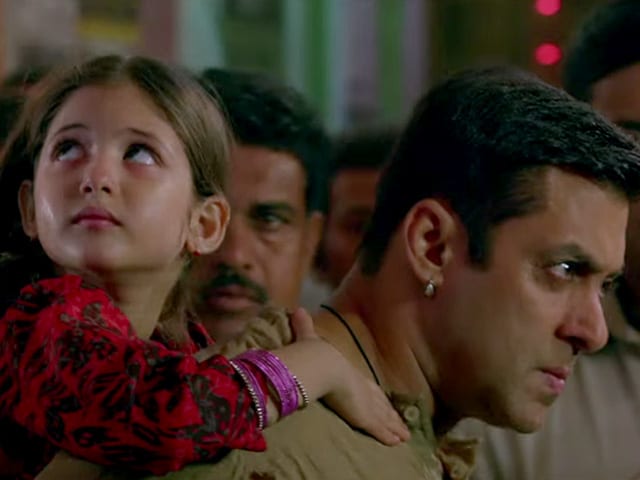
It is worth starting with the film's denouement  The last scene of the film is shot in the snows of Kashmir. A huge crowd of common Pakistanis defy military orders and knock down the high-tension wall separating the Partition Twins in order to let their new-found hero Bajrangi Bhaijaan return to India and reunite with his loved ones after having accomplished his Mission Impossible. He has just succeeded in reuniting, in turn, a sweet little girl (who lost her speech after an accident in childhood and who had lost her way in India after being separated from her mother), with her family in Pakistani Kashmir. All of this is achieved without visas and passports - just with lots of help from Pakistani friends who work for a media lovingly curious about India, and who ride colourful buses and are willing to lie in unison to the authorities if necessary - in order to enable safe passage for their ‘trespassing’ Indian visitor on a noble mission.

A simpler denunciation of the modern system of nation-states, a cowardly, cruel import in the first place from the God-forsaken (hypocritically “secular”) Western world, is difficult to imagine. Its deep-seated indifference to human well-being and its routine cruelties on all sides are in evidence throughout the movie. Love for one’s country is a wonderful thing, the movie seems to agree with Albert Einstein, but must it stop at the border? And why must love have to stand in queues for passports and visas? Shaahon ke darbar mein kahin ishq jhooka hai, I can hear Geeta Dutt sing behind me. In a memorable scene, poor Bajrangi goes with little Munni to the Pakistan High Commission in Delhi to look for a visa - without a passport in hand! Not only is he summarily dismissed, he is witness to a riot organised by a Hindutva mob trying, in the language they know best, to get back to India a certain ‘Karamjeet Singh’, held by Pakistani authorities. Bajrangi has to defend himself and Munni against them with the help of a bamboo bayonet which has “POLICE” emblazoned on it!

The film does not spare the religionists who are always in search of the political capital that God can help them accumulate and disburse. Salman’s character, Pawan Kumar Chaturvedi, is a bumbling dropout from Pratapgarh (UP) who clears Class X exams at age 30, on the 10th attempt, giving his father a fatal heart attack in the process! He becomes a Hanuman-bhakt after failing at the local sport of public choice, wrestling. Masculine bravado is mocked when it turns out that Pawan gets tickled when he is tackled! No one ever performed a better judo on the RSS - one of whose shakhas is seen fleetingly in one scene. 

Love conquers even ardent vegetarianism when we find Bajrangi Pawan Kumar Chaturvedi arranging a feast of chicken for little Munni when he realizes that she is “Mohammedan” and finds her secretly enjoying a meal in a Muslim household in Jama Masjid.

Pawan’s slogans throughout are “Jai Shri Ram!” and “Jai Bajrang Bali ki!” They could not cut closer to the jaw-bone. His faith is so redoubtable that even in Pakistan he looks for Hanuman-Bhakts!

During the last sequence, shot at the snowed-in border in Kashmir, when the emotional melody Tu jo mila returns as a reprise, I found myself singing along “kyonki tu dhad-kan main dil!” When Munni became Shaheda again and her speech returned as she bid goodbye to her beloved Pawan, I realised I was in a pool of prideful tears, immensely grateful to be born to the part of the world I have been born to! For I can see no such movie even being conceived by Hollywood in which - for instance, the Americans and the Russians could unite as a people, bypassing and rejecting their governments altogether. Unimaginable! For such social and cultural genius, no less for the faith that hundreds of millions carry in their peaceful, and ultimately friendly hearts, our Sub-Continent is utterly unique. Forrest Gump Bajrangi learns to acknowledge and say “Allah haafiz!” in Pakistan, much as some of his Pakistani friends learn to follow and say “Jai Bajrang Bali ki!” 

God is one. His forms are countless many. This is the message. It is this Great truth that will bring our people together again one day.

We have already seen the first real consequence of this landmark film. Geeta is a young “Indian” woman of 22, who is unable to speak. She lost her way to “Pakistan” many years ago. She was found by someone who took her to the famous Edhi Home in Karachi. Despite repeated attempts by people, Indian authorities took no notice of her, let alone help her return home. Now, after Bajrangi Bhaijaan, Foreign Minister Sushma Swaraj asked her ambassador in Islamabad to visit Geeta and help bring her back. Is there another part of the world where popular art has more real consequences?!

Judging from the popular reception of the film in both India and Pakistan (it has broken all box-collection records in both countries), Bajrangi Bhaijaan has achieved at a stroke what a thousand State-level dialogues and a hundred erudite tomes on war and peace in the Sub-Continent could not: It has cleared the room for a new, intelligent imagination of love, faith and faithful coexistence in this turbulent part of the earth. The beauty of Kashmir and Thar are invoked to metaphorize what is at stake in the cowardly shenanigans of leaders, armed forces, warlords and terrorists, or for that matter, in the shouting matches of warmongers on television or the laboured analyses of many intellectuals. While we certainly need good, incisive and accurate analysis, what we need even more is the public imagination to build happy, creative, peaceful narratives of faithful coexistence in the face of machine-guns, armoured vehicles, electric fences, high-security prisons, irresponsible governments and media, intelligence agencies, armed forces and terrorists virtually hell-bent on pre-empting and sabotaging any such collective initiative.

In this enterprise Bajrangi Bhaijaan succeeds beautifully at a popular level. The entertainment from one end of the film to the other is non-stop! Perhaps Salman’s existential predicament - born to a gifted Muslim Bollywood writer (no less than the co-scriptwriter of the game-setting Sholay) and a Marathi mother, making him the very embodiment of an Indian in so many ways! - helped him conceive the idea of a funny film on such a serious theme.

Now Salman has set a higher bar for himself than he, perhaps, ever has. He has a lot to live up to now!


For you, Salman..

Hum ko nahi maloom Salman ki tum doshi ho athva nahi. Ki ghalati tumhaari thhi ya phir kisi aur ki, ki tumne hiran ki hatya ki athva nahi. Insaan hoon, vakeel ya antar-yaami nahi. Nyaya aur kaanoon ki cheezein main nahi samajhta. Lekin itna jaanta hoon ki Khuda ya toh nyaya-poorna ho sakta hai ya phir karunawaan. Uska dono hona asambhav hai. Aur nyaya aur karuna ke beech agar hum se kisi ne bola choon-ne ko, toh is mein koi shaq nahi ki mera rujhaan kis taraf hoga.

Sau khoon maaf karne ke liye toh gantantra ke buzdil leaderaan ya phir sadiyon mein ek baar aane waale Gautam Buddha ya Mahatma Gandhi ki zaroorat padti hai. Anguli-maal sabse sahan nahi ho paata. Lekin ek-do khoon maaf karne laayak toh hum mein se bahut saare hain. Un mein se bahut se log sarkaarein chalaana jaante hain, sarkaaron ka samarthan aur unki sahaayta toh karte hi hain. Aur aaj-kal toh ek mahaan desh-vyaapi-vyaapam chhida hua hai. Toh phir hum tumhaare gunaahon (ya tathaakathit gunaahon) ko kis nazar se dekhein? Agar tum qabool kar lo apni ghalati, to phir tumhe kyon na maafi mile?

Bajrangi Bhaijaan ke baad hamaari taraf se ab sab kuchh maaf hai Salman…magar tumhe ab line pe bane rehna hoga. Samay bahut jatil hai, aur bahut kam bhi. Kahin Shiv Ji ka balance khatam na ho jaaye! Agar tumhaare jaison aur tumhaare mureedon ke jaison ne aadatein nahi badlin, aur samaaj mein bhog, upbhog aur himsa badhti gayin, toh ab catastrophe ‘testostrophe’ ke roop mein aayegi. Climate change raftaar pakdega, aur prithvi se uthega taandav ka vyakul swar: bhoo-kump, baadh, aur samudri toofaanon ke maadhyam se dharti maata hum sab ko - haan, tumhaari pyaari Munni/Shaheda aur Rasika ko bhi - apne lapete mein le legi! Hindustan-Pakistan ka naam-o-nishaan nahi bachega jab Himalaya koyle ki maha-jalan aur tel ki maha-khapat se gal ke hamaare upar haabi ho jaayega…Bajrangi Bhaijaan ke zariye tumne ye dikha diya Salman, ki “Pakistan Zindabaad!” aur “Bharat Mata ki Jai!” jaise naaron ke liye ap prithvi par bilkul bhi wakht nahi. Devi-Devata ab be-chayn ho rahe hain…

Hum sab ko ek swar mein aawaaz deni hai: Jai Bajrang Bali ki!Dharti maata ki Jai! 

Tumhaara gaanaa amar rahe!:

https://www.youtube.com/watch?v=WL8KbSR4Pno