Showing posts with label Imperialism. Show all posts

Sunday, 30 August 2015

An Ode to Cowards

You send your unmanned drones to murder babies in Afghanistan.
You rape and impregnate little girls in the name of bringing them
       closer to Allah.    
You murder Mohsin and Pansare, Dabholkar and Kalburgi,
       besmirching the noble name of Ancient India.

All of you should be awarded a desert island on Mars to debauch
      yourselves in toto, murder each other to mutually assured 
      extinction, and make the red planet redder.

Only then will our beloved Earth bring forth the love to bless its 
         soil and its innocent children.
Only then shall there be Christmas on Earth.
Only then shall Jannat appear.
Only then shall the reign of Shaashvat commence.

Of one thing I am sure.
Your kind is the same, though they go by different names.
Our kind are all different, yet one.
You will lose.
And we will win!
Even if we do not live to tell the tale.
And you live to perdition and eternal damnation, cursed with
        infinite regret.

Saturday, 15 August 2015

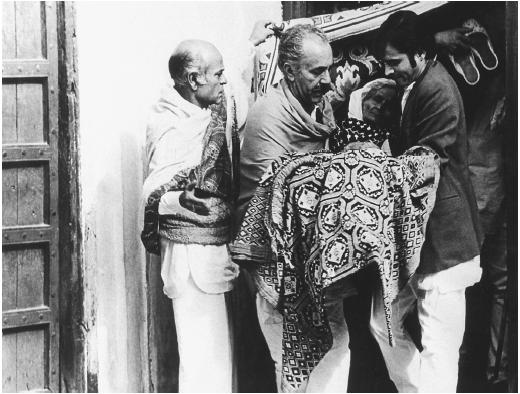
Independence and Partition - I: Azaadi aur Garam Hawa

After watching Masaan for a second time last weekend, I realised, while discussing the film with a friend, that one of the big gaps in my cultural upbringing is the fact that I somehow missed seeing M.S.Sathyu's Garam Hawa, perhaps because I was too young when it was released (1974) and later, I was away from India for nearly two decades. A story in last weekend's edition of Hindustan Times informed me that the film was available on Youtube. So I promptly decided to to see it, and now realise why so many regard it to be one of the great films of Indian cinema.


Appropriately, I finished watching it yesterday, August 14, just in between the anniversary of Pakistan's and India's Independence Day celebrations (in fact, the two days are actually the same when you consult the Indian Independence Act of 1947: Karachi's The Dawn had a fine piece the other day on the theme: http://www.dawn.com/news/1199235)

The film is altogether too chilling, too real for our bubbled lives of 2015. It begins with a scene whereby Salim Mirza (the immortal Balraj Sahni) has just bid goodbye to his elder sister, who has caught the one-way train to Pakistan. On the way to his factory, he remarks to the taanga-waallah:

"कैसे हरे-भरे दरख़्त कट रहे हैं इस हवा में!" 

("Such leafy, green trees are being felled by this wind these days!")

And the taanga-waallah responds with workmanlike gusto:

"बड़ी गर्म हवा है मियाँ, बड़ी गर्म!" 

("It is a very hot wind, very hot!")

Every moment of the next two hours, the viewer is kept on the edge of the seat, as one tragic scene after another unfolds with premonitory perfection.

What a film! The movie breaks your heart​ again and again, and yet again​, but ends on a note of redemptive hope, howsoever meagre.​ It should be watched compulsorily, especially by our young people in schools and colleges: 

https://www.youtube.com/watch?v=QZTvF_1AN8A​


This 2014 interview ​that Teesta Setalvad (who says she has seen the film 27 or 28 times!) does with MS Sathyu and Shama Zaidi, ​the film-maker/scriptwriter​,​ on the making and re-release of Garam Hawa (as Garm Hava) is worth watching too: 

https://www.youtube.com/watch?v=bEGhKn4LhzA


The cruel absurdity of Partition was understood even by the man invited to draw the line between the two birth-marked Sub-Continental twins. Cyril Radcliffe "never forgave himself. He was summoned to Delhi in 1947 — he was neither an administrator nor a cartographer, but only a lawyer, who had never set foot in India before — with the specific assignment of partitioning Punjab and Bengal on religious lines. He arrived on July 8 that year, and having done his job, left India the very day it attained Independence, burning all his papers and without collecting his fee, 40,000 rupees — so appalled he was by the killings." Over a million people were killed and at least 12 million were rendered homeless to serve the political ambitions of our wicked leaders. Gandhiji was virtually alone in his mourning.

There are farmers, both on the Indo-Pak and on the Indo-Bangladesh borders, whose home falls in one country and their fields in another. There are neighbours' adjoining courtyards through which the Radcliffe Line runs!:

Before we are Hindus and Muslims, we are human beings, equal in the eyes of the one and only Creator. Not only was this borne out once when a Hindu bigot had to unknowingly accept a Muslim man's blood for his bleeding child in hospital, there is also evidence aplenty in our traditions of art, literature, and music. Yesterday's edition of The Hindu had a splendid piece which reports the influence that the great Ustad Amir Khan has had on a very large number of musicians in succeeding generations, including on the likes of Vidushi Kishori Amonkar, and Pandit Ulhas Kashalkar:

http://www.thehindu.com/features/friday-review/ustad-and-the-world-of-gharanas/article7535908.ece


If Indian and Pakistani leaders in 2015 have any courage left in their hearts whatsoever, they will never allow 1947 to repeat itself. Partition is the massive, unacknowledged gaping wound in our history. Even before it had begun to heal, more pogroms were launched, more wars fought. The pathology has only grown. The denial has become cancerous now. It shall prove truly fatal, unless the facts and passions are faced through mutual acknowledgement of very inconvenient truths. We urgently need memorials, museums, histories, films, literature, art, and, above all, a Truth and Reconciliation Commission, howsoever belated that may be. 

One reason to study and acknowledge history collectively, in the public sphere, is to prevent it from repeating itself farcically, once communities have grown accustomed to the gravity of the original tragedy and have all but forgotten its spiritual, emotional, and physical impact when the bloodstains had not dried up.


Monday, 10 August 2015

Cowardice thrives in the age of barbarism !

Yesterday (Sunday), The Hindu carried my piece on the murder of Cecil the Lion by a cosmetic dentist from Minnesota:


http://www.thehindu.com/features/magazine/aseem-shrivastava-on-cecil-the-lions-murder/article7512452.ece

A friend remarked the other day that to a grizzly bear, a Hindu, a Muslim, a Jew, a Catholic, a Protestant would all taste the same - just like chicken tastes roughly the same to us humans, regardless of whether it has been reared on this continent or some other - and this is even more true in the age of the global stupid!

And while we are still speaking about just how much maturer than humans animals are proving to be, please take 3 more minutes to look at this cutting satire too. It is brilliantly titled More-on: The Lion Dentist

http://www.huffingtonpost.com/bernie-shine/moreon-the-lion-dentist_b_7918754.html?utm_source=change_org&utm_medium=petition&ir=India&adsSiteOverride=in


Saturday, 8 August 2015

Salman ko Salaam !


“Kyonki tu Dhad-kan…main dil!”

When Munni and Pawan made me weep


Today is August 9, 2015. Exactly seven decades have passed since Washington committed perhaps the greatest war crime in the history of man by testing a plutonium bomb on the Japanese city of Nagasaki, close on the heels (just three days) after testing a uranium weapon on Hiroshima’s innocents. I say “testing” because such weapons were new to our species and it was yet to be known precisely what their destructive potential was. These two tests in real time helped zero in on the right numbers (for that time. The remarkable thing is that we still do not know exactly how many - obviously non-White - innocents were butchered in this dual savagery. Estimates vary between 130,000 and 250,000). 

Equally importantly, “Little Boy” and “Fat Man”, as the twin bombs affectionately came to be referred to by the Allied military establishment, also enabled the Untidy State of America to supersede the rising Soviet Union and define the contours of the remainder of the century (by controlling the terms of the Cold War and its hundreds of hot proxies in the “Third” World), if not also the distant outlines of the century we now live in. 

I remember that many years ago, after India and Pakistan had conducted their nuclear tests, some words of war criminal Henry Kissinger had leaked in the media and he was caught saying that the only two countries on earth which are “nuclear neighbours” are India and Pakistan and they offer the (obviously for Kissinger, salacious) possibility of what an actual nuclear “exchange” between such powers would look like in reality (as opposed to the war-games which provide only conjectural data to military planners and strategists).  

Warmongers and leaders on both sides of this foolish, metallic, electrically charged border have done everything possible in the last 17 years to bring everyone living in this part of the world rapidly closer to the day of nuclear reckoning. I remember a cartoon from around 1998 in which India and Pakistan go to (yet another) war. Islamabad launches a nuclear-tipped missile at New Delhi. It falls short and lands in Lahore itself, decimating the ‘city with a soul’ instantaneously. New Delhi retaliates by taking aim at Islamabad but instead finds Amritsar’s Golden Temple in the way. In their enthusiastic ghost sonata, in the spirit of Stanley Kubrick’s brilliantly funny Dr. Strangelove, leaders on both sides declare victory!


“Jai Bajrang Bali ki!”

It is with this background, supplemented by the latest refinements of absurdity on both sides of the border, that the film Bajrangi Bhaijaan is to be viewed.


I had refused all these years, on principle, to watch a Salman Khan film. Not only has he made a hobby of taking the law into his own hands, what an example he has set for boys and young men across the kasbas and metros of this land! With each sock on the jaw of a ‘bad’ guy, he not only shows the way to ‘handy’, ham-fisted, readymade justice, he also appears to be saying to his hundreds of millions of fans around the world “it is alright never to grow up. Life in the American global age is an endless adolescence - especially if you are a boy - and not only is it ok to indulge it, it is something to be celebrated with an impatient, agile fist!”

How could anyone outside an asylum for the delinquents put up with this hormonal nonsense?

Yet, yesterday I broke an important personal code and went to watch Bajrangi Bhaijaan at the strong recommendation of an old and trusted friend. Serendipitously, I found that while I was watching the film in Delhi, my parents too were in a Gurgaon multiplex watching the same film! Certain things are meant to be and sometimes our conscious minds must retire from their supervisory duties. So I left my thought-policeman at home and went to the Vasant Kunj Mall to give Salman a first - and last! - chance.

I was not disappointed. 

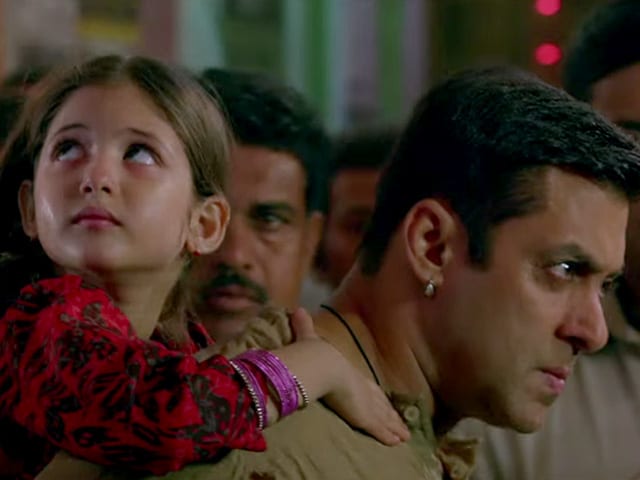
It is worth starting with the film's denouement  The last scene of the film is shot in the snows of Kashmir. A huge crowd of common Pakistanis defy military orders and knock down the high-tension wall separating the Partition Twins in order to let their new-found hero Bajrangi Bhaijaan return to India and reunite with his loved ones after having accomplished his Mission Impossible. He has just succeeded in reuniting, in turn, a sweet little girl (who lost her speech after an accident in childhood and who had lost her way in India after being separated from her mother), with her family in Pakistani Kashmir. All of this is achieved without visas and passports - just with lots of help from Pakistani friends who work for a media lovingly curious about India, and who ride colourful buses and are willing to lie in unison to the authorities if necessary - in order to enable safe passage for their ‘trespassing’ Indian visitor on a noble mission.

A simpler denunciation of the modern system of nation-states, a cowardly, cruel import in the first place from the God-forsaken (hypocritically “secular”) Western world, is difficult to imagine. Its deep-seated indifference to human well-being and its routine cruelties on all sides are in evidence throughout the movie. Love for one’s country is a wonderful thing, the movie seems to agree with Albert Einstein, but must it stop at the border? And why must love have to stand in queues for passports and visas? Shaahon ke darbar mein kahin ishq jhooka hai, I can hear Geeta Dutt sing behind me. In a memorable scene, poor Bajrangi goes with little Munni to the Pakistan High Commission in Delhi to look for a visa - without a passport in hand! Not only is he summarily dismissed, he is witness to a riot organised by a Hindutva mob trying, in the language they know best, to get back to India a certain ‘Karamjeet Singh’, held by Pakistani authorities. Bajrangi has to defend himself and Munni against them with the help of a bamboo bayonet which has “POLICE” emblazoned on it!

The film does not spare the religionists who are always in search of the political capital that God can help them accumulate and disburse. Salman’s character, Pawan Kumar Chaturvedi, is a bumbling dropout from Pratapgarh (UP) who clears Class X exams at age 30, on the 10th attempt, giving his father a fatal heart attack in the process! He becomes a Hanuman-bhakt after failing at the local sport of public choice, wrestling. Masculine bravado is mocked when it turns out that Pawan gets tickled when he is tackled! No one ever performed a better judo on the RSS - one of whose shakhas is seen fleetingly in one scene. 

Love conquers even ardent vegetarianism when we find Bajrangi Pawan Kumar Chaturvedi arranging a feast of chicken for little Munni when he realizes that she is “Mohammedan” and finds her secretly enjoying a meal in a Muslim household in Jama Masjid.

Pawan’s slogans throughout are “Jai Shri Ram!” and “Jai Bajrang Bali ki!” They could not cut closer to the jaw-bone. His faith is so redoubtable that even in Pakistan he looks for Hanuman-Bhakts!

During the last sequence, shot at the snowed-in border in Kashmir, when the emotional melody Tu jo mila returns as a reprise, I found myself singing along “kyonki tu dhad-kan main dil!” When Munni became Shaheda again and her speech returned as she bid goodbye to her beloved Pawan, I realised I was in a pool of prideful tears, immensely grateful to be born to the part of the world I have been born to! For I can see no such movie even being conceived by Hollywood in which - for instance, the Americans and the Russians could unite as a people, bypassing and rejecting their governments altogether. Unimaginable! For such social and cultural genius, no less for the faith that hundreds of millions carry in their peaceful, and ultimately friendly hearts, our Sub-Continent is utterly unique. Forrest Gump Bajrangi learns to acknowledge and say “Allah haafiz!” in Pakistan, much as some of his Pakistani friends learn to follow and say “Jai Bajrang Bali ki!” 

God is one. His forms are countless many. This is the message. It is this Great truth that will bring our people together again one day.

We have already seen the first real consequence of this landmark film. Geeta is a young “Indian” woman of 22, who is unable to speak. She lost her way to “Pakistan” many years ago. She was found by someone who took her to the famous Edhi Home in Karachi. Despite repeated attempts by people, Indian authorities took no notice of her, let alone help her return home. Now, after Bajrangi Bhaijaan, Foreign Minister Sushma Swaraj asked her ambassador in Islamabad to visit Geeta and help bring her back. Is there another part of the world where popular art has more real consequences?!

Judging from the popular reception of the film in both India and Pakistan (it has broken all box-collection records in both countries), Bajrangi Bhaijaan has achieved at a stroke what a thousand State-level dialogues and a hundred erudite tomes on war and peace in the Sub-Continent could not: It has cleared the room for a new, intelligent imagination of love, faith and faithful coexistence in this turbulent part of the earth. The beauty of Kashmir and Thar are invoked to metaphorize what is at stake in the cowardly shenanigans of leaders, armed forces, warlords and terrorists, or for that matter, in the shouting matches of warmongers on television or the laboured analyses of many intellectuals. While we certainly need good, incisive and accurate analysis, what we need even more is the public imagination to build happy, creative, peaceful narratives of faithful coexistence in the face of machine-guns, armoured vehicles, electric fences, high-security prisons, irresponsible governments and media, intelligence agencies, armed forces and terrorists virtually hell-bent on pre-empting and sabotaging any such collective initiative.

In this enterprise Bajrangi Bhaijaan succeeds beautifully at a popular level. The entertainment from one end of the film to the other is non-stop! Perhaps Salman’s existential predicament - born to a gifted Muslim Bollywood writer (no less than the co-scriptwriter of the game-setting Sholay) and a Marathi mother, making him the very embodiment of an Indian in so many ways! - helped him conceive the idea of a funny film on such a serious theme.

Now Salman has set a higher bar for himself than he, perhaps, ever has. He has a lot to live up to now!


For you, Salman..

Hum ko nahi maloom Salman ki tum doshi ho athva nahi. Ki ghalati tumhaari thhi ya phir kisi aur ki, ki tumne hiran ki hatya ki athva nahi. Insaan hoon, vakeel ya antar-yaami nahi. Nyaya aur kaanoon ki cheezein main nahi samajhta. Lekin itna jaanta hoon ki Khuda ya toh nyaya-poorna ho sakta hai ya phir karunawaan. Uska dono hona asambhav hai. Aur nyaya aur karuna ke beech agar hum se kisi ne bola choon-ne ko, toh is mein koi shaq nahi ki mera rujhaan kis taraf hoga.

Sau khoon maaf karne ke liye toh gantantra ke buzdil leaderaan ya phir sadiyon mein ek baar aane waale Gautam Buddha ya Mahatma Gandhi ki zaroorat padti hai. Anguli-maal sabse sahan nahi ho paata. Lekin ek-do khoon maaf karne laayak toh hum mein se bahut saare hain. Un mein se bahut se log sarkaarein chalaana jaante hain, sarkaaron ka samarthan aur unki sahaayta toh karte hi hain. Aur aaj-kal toh ek mahaan desh-vyaapi-vyaapam chhida hua hai. Toh phir hum tumhaare gunaahon (ya tathaakathit gunaahon) ko kis nazar se dekhein? Agar tum qabool kar lo apni ghalati, to phir tumhe kyon na maafi mile?

Bajrangi Bhaijaan ke baad hamaari taraf se ab sab kuchh maaf hai Salman…magar tumhe ab line pe bane rehna hoga. Samay bahut jatil hai, aur bahut kam bhi. Kahin Shiv Ji ka balance khatam na ho jaaye! Agar tumhaare jaison aur tumhaare mureedon ke jaison ne aadatein nahi badlin, aur samaaj mein bhog, upbhog aur himsa badhti gayin, toh ab catastrophe ‘testostrophe’ ke roop mein aayegi. Climate change raftaar pakdega, aur prithvi se uthega taandav ka vyakul swar: bhoo-kump, baadh, aur samudri toofaanon ke maadhyam se dharti maata hum sab ko - haan, tumhaari pyaari Munni/Shaheda aur Rasika ko bhi - apne lapete mein le legi! Hindustan-Pakistan ka naam-o-nishaan nahi bachega jab Himalaya koyle ki maha-jalan aur tel ki maha-khapat se gal ke hamaare upar haabi ho jaayega…Bajrangi Bhaijaan ke zariye tumne ye dikha diya Salman, ki “Pakistan Zindabaad!” aur “Bharat Mata ki Jai!” jaise naaron ke liye ap prithvi par bilkul bhi wakht nahi. Devi-Devata ab be-chayn ho rahe hain…

Hum sab ko ek swar mein aawaaz deni hai: Jai Bajrang Bali ki!Dharti maata ki Jai! 

Tumhaara gaanaa amar rahe!:

https://www.youtube.com/watch?v=WL8KbSR4Pno


Saturday, 1 August 2015

Premchand as prophet of modernity


Yesterday, July 31, 2015, was Munshi Premchand's 135th birth anniversary. I was moved to write the piece below...


Munshi Premchand: 1880-1936


Globalization, Guns and Gluttony
Munshi Premchand’s take (1928)

Aseem Shrivastava


A very dear friend enjoys her birthday today. She never fails to remind me that the greatest master of modern Hindi prose was also born exactly 135 years ago. (She never gets to the topic of who the next greatest master might be!)

Dhanpat Rai Shrivastava’s birthplace is the village of Lamhi, near Benares.  Apart from his genre-defining Hindi fiction, he also wrote some of the finest Urdu novels of his day. 

Premchand was the simplest of men, a point emphasised by all his biographers, including his devoted wife, Shivrani Devi, and their admiring son, Amrit Rai. Shivrani Devi’s Premchand Ghar Mein and Amrit Rai’s Kalam ka Sipaahi both sit on my mother’s erudite bookshelf. I have only browsed these wonderful volumes, procrastinating a fuller reading to that elusive summer of the kind that does not make itself available to reluctant prisoners of cyberspace anymore (my life ambition used to be to write without footnotes; now it has changed to going permanently offline.)

Being the simplest of men, Munshi Dhanpat Rai, was, at once, gifted with a formidably sophisticated intellect which could render the distilled essence of a complex theme in a handful of concisely penned paragraphs. If I recall any of Mishraji’s memorable pedagogy at St.Michael’s, Patna in the mid-1970s, and those stories from the eight-volume Mansarovar he encouraged us to read in school, this rare blend of simplicity and sophistication puts Premchand in an enviable ‘league of one’ (or two, if one also thinks of Manto) so far as modern North Indian writers go. I remember Mishraji’s words - ye thhe lok-saahitya ke asal baadshaah! Out come tumbling from the bucket of memory titles of piercing short stories like Idgaah, Boodhi Kaaki, Panch-Parmeshwar, Sadgati and Shatranj ke Khilaari, each a gem in its own right, alone enough to suggest the might of the pen that fathered the tales.

Premchand is renowned no less for his epic novels - Gaban, Godaan and Karmabhoomi among them. My eldest paternal Uncle, one of whose aunts was Premchand’s daughter, casually told me the story of how he was perhaps the first reader of Godaan. As a young boy he used to sit by his great Uncle and go through the unedited pages of the first draft of the novel, as Premchand penned the pages at electric speed, sitting outside the maternity ward of Dufferin Hospital in Sagar (Central Provinces), waiting for his daughter to give birth to her first child in the early 1930s. 

To inspire us to creative work, the elders never failed to remind us in childhood that our family was so closely linked to Premchand. What I can recall for myself are the meetings between our own grandfather and Amrit Rai, back in the late 1960s and early 1970s, when our entire home in Sagar would rock with the recurrent echo of their uninhibited laughter. Alas, No one laughs like that anymore!

I also remember the many times that we would stay at Amrit Rai’s (Allahabad waale Babba’s) lovely home Dhoop-Chhaon on Hastings Road (now Nyaya Marg), in Allahabad. Both Babba and Dadi would welcome us with memorable warmth and regale us with one story after another. Dadi’s stories for children were fabulous!

The last time I stayed there was quite recently. I had taken my friend (whose birthday also happens to be today, coincidentally) to the 2013 Kumbh Mela. Bhullu Chacha (the noted critic Alok Rai) and Rajul Chachi had welcomed us with customary affection and fed us those sumptuous moti-rotis with home-made makkhan you got only at Dhoop-Chhaon.

An obscure essay?

It was also exactly two years ago when, on this very day, July 31, my incredulous mother (a daily reader of Jansatta for as long as I remember), asked me to read a small op-ed piece in the newspaper titled Saamyavaad zyaada khatarnaak hai (‘Communism is deadlier’). The unnamed author was making an argument (which I shall share presently) to the effect that there are tendencies within the modern world which make communism an even more dangerous prospect than the exploitative capitalism with which everyone is only too familiar. That a known devil is better than an unknown one - or so it seemed from the short piece. What made both my mother and I exclaim in unison was the parenthetical postscript to the piece. The editor claimed that the piece was written by none other than Premchand himself, in an obscure journal in 1928!

Given how we were brought up to believe - by friends and cultural lore, no less than by our own family - that Premchand reserved the largest part of his great heart for the poor (many claiming that he was certainly a ‘leftist’ if not an outright ‘communist’) - this seemed, on the face of it, very difficult to believe.

It was only when I read the piece a second time, and this time much more slowly and carefully, that the lines one associated with Premchand’s unique stream of thought began to surface from the depths of the essay.

Before I tell you the story of my authentication of the article, it is worth going into the details of Premchand’s prescient and prophetic argument.


Raajyavaad aur Saamraajyavaad

Premchand begins his essay with two simple sentences. “We live in times of imperialism. Earlier eras belonged to monarchy.”

For him the difference is profound. Both political systems rest on conquest. However, he points out that in the age of monarchy, conquest was a one-off phenomenon, which would establish the victorious king’s bravery, enable him to exact tribute and, where deemed necessary and desirable, convert the conquered to his own preferred religion. 

He argues that times of imperialism are altogether different. Here the goal is not just one of the three simple ones just stated. The goal is commercial. Traders and their organisations need to expand their markets, Premchand says. And they want to do it endlessly, since there is no limit to the systematic accumulation of wealth. 

This is the key conclusion he arrives at with typically elementary economy: conquest under imperial modernity is therefore permanent, an enterprise in perpetuity. It can, as we know, go on for 500 years and more, as long as Mother Nature tolerates galloping human greed.


The Labour Aristocracy

This is where the real nub of Premchand’s argument is: “ruling over a weak nation is as important for the labourers of powerful nations as for their traders.” They too, he notices, want good food, good clothes, lots of entertainment, and so on. And if this requires their country and its traders to dominate other countries and their workers, they learn to ignore the fact.  It is a fact too remote from their own daily drudge. The entire society thus becomes complicit in the imperial venture. Premchand’s own language is so colourful while arguing this that it merits a long quotation: 

...to keep any enslaved community under control is in the interests of not only the king and trader but of the entire community, and the entire clan rules as one community. In the olden days it was the rule of one individual. He was the ‘bridegroom’ of the party. Today, every member of the bridegroom’s party, however lowly he might be - like a barber or a thakur - is a bridegroom. In the times of Tartars and Mughals water-carriers or cleaners never dreamed of ruling over a community.

Today a common coal-miner of Belgium or England knows and understands that he is ruling over a weak community. A king in earlier times could be happy or angry. All his tasks were done under the influence of his own feelings and thoughts. But to please a whole community is much more difficult than to offend it. Such is the mentality of a whole community.  Things that we cannot even think of doing individually are executed collectively without any hesitation. One individual can be an idealist, can abandon selfishness, but a whole nation cannot be idealist. It is possible that a monarch feels pity at the sight of India’s miserable plight. But it is impossible that the entire British community sacrifices their interests at the alter of pity and justice. 

Premchand probably did not know that Lenin had noticed similar facts when he pointed to the labour aristocracy of advanced capitalist nations as one of the big stumbling-blocks to a world revolution. 

Premchand was possibly aware that Rabindranath Tagore had pointed to the enormous perils of collective selfishness in his lectures on Nationalism in India, China and Japan during the First World War. However, Premchand analyses the dangers of social greed in very different words, using other images.
And what about communism?

So this is how, in brief, Premchand - a writer and man infinitely more rooted in his place and time than the writer or any likely reader of this article -   understands the modern world. Notice that Premchand is no uncritical partisan of tradition, if his novels and stories tell us anything about his imaginative conscience. But nor is he an enthusiastic votary of modernity that his socialist and other acolytes would like to claim him for. 

Here is what Premchand felt about communism in the modern world, long before even the Gulag revelations about Stalin’s devastating regime:

There was a time when communism stirred the hearts of weak nations with hope. When the proletariat will rule the world, there will no trace of slavery, subjugation or social inequality. Great hopes were pinned on communism.

However, now the experience is that the communist movement is only the victory of the labourers over the capitalists. It is not the victory of justice over injustice, of truth over untruth. There will not be any reduction in all the inequalities, injustices and selfishness which are synonymous with capitalism. In fact, the possibility of their turning more horrifying is greater.

Like Tagore, Premchand’s humanism is too deep for either side to legitimately see him as their own unique mascot. He transcends the binary of tradition and modernity, the infinitely alert eye of his soul casting its gaze dispassionately at the growing, living museum of horrors and monstrosities around him.  

Premchand was too honest to believe in the facile Utopian answers that modernity churns out in every generation, ours being only the most impatient example of the phenomenon. His perspective transcends the lazy binaries of contemporary thought, leaving us as close to the threshold of the social truth as it is possible for the written word in any language or vernacular to reach. In the bargain, he does not leave us feeling emptied and nihilistic as many critical thinkers tend to do. Like the other immortal story-teller from this part of the world, Saadat Hasan Manto, his intellectual skepticism is not stolen from the vast optimism of his heart. It is fed by it, even as it feeds it in turn. One returns from Premchand’s stories marvelling at the courage with which beleaguered actors uphold human dignity against the stiffest of odds, in the most trying of circumstances. What else could inspire greater hope!


Authenticating the article

After reading the version of Premchand’s article published in Jansatta, I set about trying to verify its bona fides, inquiring hither and thither from Hindi writers and journalists, from friends who regarded themselves to be Premchand veterans, even from so many of Premchand’s descendants, if anyone knew anything about the piece. People confessed complete ignorance. Times have declined so precipitously that one person even claimed that the piece published in Jansatta was likely part of a plot on the part of some people belonging to the Hindu Right, trying to claim Premchand for themselves, denying his involvement with the Progressive Writers Association, and so on. 

After great difficulty a Physics professor friend of mine at the University of Delhi succeeded in getting a historian friend of his, also at DU, to locate the original version Raajyavaad aur Saamraajyavaad in a CD-archived collection of a journal called Swadesh which used to be published from Gorakhpur in the early part of the last century. When I obtained the PDF, Premchand’s piece occupied just one modest, easily overlooked, page of the journal in the issue of March 18, 1928.

My mother Jayawati Shrivastava translated the original version of the article. She translated the title as Monarchy and Imperialism. I shared both the Hindi original and the translation with various friends, colleagues and students over emails. So far as I have been able to find out, no  English translation of the article has so far been published anywhere.


Learning from Premchand in today’s global world

Recently, Shashi Tharoor won himself a lot of patriotic spurs when he argued, impressively and convincingly, in the lion’s den of the British academy Oxford University, that Britain owes reparations not only to India but to scores of other countries, because of the sheer enormity of the debt - material and psychological - it lived off for  two centuries and more. Tharoor did not insist on a monetary payment, beyond a token quid a year. But he did want Britain to say “sorry”. An apology for imperialism is the morally minimalist route that Tharoor suggested to his Oxford rivals.

However, if Premchand is right, then the commercial market processes of modernity are themselves socially corrosive and ultimately destructive, regardless of whether they work to the advantage of people white in skin or brown (or black). Remember that such conquest is perpetual, as the great writer understood it. “Sorry”, in such a case, is a supine word in the context if the underlying processes that generate the structural injustices persist and continue to proudly outlive the apology.

So we must rightfully ask Mr.Tharoor, with all due respect: Don’t the corrosive market processes of modernity persist in the global world and haven’t some of them also shifted geographical and social location such that he (and a small number of we) now derive enormous material benefits from the same processes, while putting into mortal peril not merely hundreds of millions of the underprivileged, but also our own progeny, because we blithely continue to take decisions which are brutally destabilising the ecology of the Sub-Continent, even as we get morally self-righteous vis-a-vis the affluent imperial nations and their contribution to climate change? 

Somebody quickly needs to tell Mr.Tharoor that this is 2015, not 1915...he is about a 100 years behind history! What about the sub-imperialism within India? What about our very own long-standing ‘internal colonialism’ which every day systematically ravages the lives of the rural (and the urban) poor, which displaces them from their forests, lands, livelihoods, communities and cultures with the deceiving seduction of ‘better jobs’ that ‘development’ will give them, and lands them instead in urban and metropolitan slums of squalor, evicting them subsequently whenever there are events like the Commonwealth Games, which were overseen in 2010 by a government drawn from Mr.Tharoor’s political party? Is there a Tharoor to speak for such colossal injustices as the very existence of a colonial-era land acquisition act in a free, uncolonised country? Doesn't metropolitan India need to make actual reparations, in the form of a radical change of course of policy, to Bharat? Has there been a moment during his time in the Indian State when Tharoor has categorically stood aside on such issues, and waxed with the same moral eloquence he performed at the Oxford Union a few weeks ago? 

In our book Churning the Earth: The Making of Global India, the environmentalist Ashish Kothari and I write:

“The poorest 20-40% of India’s population will be bearing a remarkably disproportionate burden of the costs of climate change, especially since they inhabit ecologically vulnerable habitats. Just like our government likes to prevail morally on the rich countries to have exemption from emissions reductions, don’t the Indian poor have a right to ask the government to place a carbon tax on the super-rich with which the disproportionate costs they have to bear for climate change (from which the rich derive the bulk of the present benefits) can be somewhat evened out? …Yet, no one in the Indian government argues in this fashion. We remember ethics only when it comes to dealing with those more powerful than ourselves.”


Premchand’s judgment of modernity

There will be those who will think that imperialism is not the same as modernity, that you can end one and need not end the other. But Premchand has already answered such hopefuls by pointing to the even greater perils of the collective selfishness that is likely to pass for ‘communism’ in the materialist modern world. What is called globalisation is little else but imperialism and rape by another, palatably euphemistic, name. Competitive socialism will be likely more materially, politically, culturally and ecologically devastating than competitive imperialism. This was Premchand’s view. 

Today, global society is based entirely on values we associate with modernity. Modernity itself rests on competitive capitalism, not ‘Enlightenment’, as is assumed by many intellectuals.  The ideals of the French revolution “liberty, equality, fraternity” have long gone into eclipse even in the lands which gave birth to them. The rush for power and wealth is the overriding global motivation now. Capitalism is rooted  in competition, in turn a legacy and ongoing product of war. So where is the surprise if society itself has become a form of everyday warfare, leading the legendary British Prime Minister Margaret Thatcher to remark famously a generation ago “there is no such thing as society”? 

Society everywhere today lives by the ‘rules’ of war because it is ruled by a war-like market, which valorises competition and competitiveness at the cost of every other human value, be it friendship or solidarity, love or compassion. The economy  has now almost fully taken the place of human community and fraternity. It runs  according to rules of war, where everything is fair or foul not according to some universally shared principle, but according to who is the responsible agent of action. The same thing we allow ourselves as obligatory patriotism is seen as ‘terrorism’ when the patriotism of another people is involved. 

In a few wise vernacular paragraphs, penned 87 years ago, Munshi Premchand anticipated all of this. He understood the modern world to be, above all, a system of power. So deep and insidious it already was in his day that he felt everyone was already a devotee of power and domination. Subjugation of countless others lower in the hierarchy was a corollary of this contagious habit. 

Premchand concluded his astonishing essay with this paragraph:

In the time of monarchies only one individual was drunk on power. Under imperialism an entire community is consumed with this headiness. And they are capable of doing anything. All the affluence, all the knowledge and science, all religions and philosophies’ of the West are narrowed down today to one word ‘selfishness’, and justice, truth, compassion, grace, rationality – everything is sacrificed at the altar of ‘selfishness’. 

The only amendment worth making to the above paragraph to render it accurate for a globalised planet in the 21st century is to replace the word ‘West’ by the word ‘world’.


**********


Here is the English translation of Premchand's 1928 article, followed by a zoomed in PDF of the original page of Premchand's (in Hindi of course) from Swadesh, March 18, 1928. To read the latter you will have to scroll vertically and laterally.


Monarchy and Imperialism

Munshi Premchand

(Translation from Hindi: Jaya Shrivastava)


We live in times of imperialism. Earlier eras belonged to monarchy. In those days a warrior attacked another country to prove his valour, to conquer it, or to spread his religion. Once victorious, his desires were fulfilled. Either the acceptance of defeat on the part of the vanquished king or the latter’s payment of a tax was enough to satisfy him. If his only aim was to spread his religion, then the vanquished king’s conversion to the victor’s religion was enough to set him free. His defeat did not stamp him with ignominy for all times to come. When a man is imbued with valour it is natural for him to show off his strength in front of others. This is pardonable. In fact this should be appreciated. Those who are powerful have a god-given right to rule over the powerless. Slavery is the punishment for weakness. This is why day in and day out, through the ages, every group has worked to acquire moats. But the humiliation suffered by the vanquished on the battlefield was considered enough for the satisfaction of the victor. After a few years there was no difference or inequalities between the victor and the vanquished. 

But we live in the age of imperialism. Today no one attacks to prove his bravery. Bravery is out of fashion these days. Today, powerful communities come together only to suck the blood of the powerless. This ambition no longer resides in the heart of the king but in the heart of traders. Groups of traders are always in search of markets for their goods that can fetch whatever price they want. Gradually they want to capture the market in a way that establishes their rights over it for all times to come. The labouring classes also have a share in the money that comes to their country through the traders. No goods can be manufactured without labourers, and nowadays labourers’ organizations are so powerful that no nation can do anything without their consent.

These labourers cannot bear any injustice in their own country. But when it comes to securing the interests of their traders abroad, they give no pause to judge what is proper or improper, what is just or unjust. They are ever keen to help the traders. They also want pretty houses to live in, nutritious food to eat, cinema theatre entertainment. Everything is necessary for them and all this pleasure can be obtained only when the goods of the traders are being consumed regularly. That is why ruling over a weak nation is as important for the labourers of powerful nations as for their traders. And in any country there are only two categories of people, traders or labourers. Landowners come under the category of traders and farmers under labourers. Therefore, to keep any enslaved community under control is in the interests of not only the king and trader but of the entire community, and the entire clan rules as one community. In the olden days it was the rule of one individual. He was the ‘bridegroom’ of the party. Today, every member of the bridegrooms’ party, however lowly he might be - like a barber or a thakur - is a bridegroom. In the times of Tartars and Mughals water-carriers or cleaners never dreamed of ruling over a community.

Today a common coal-miner of Belgium or England knows and understands that he is ruling over a weak community. A king in earlier times could be happy or angry. All his tasks were done under the influence of his own feelings and thoughts. But to please a whole community is much more difficult than to offend it. Such is the mentality of a whole community.  Things that we cannot even think of doing individually are executed collectively without any hesitation. One individual can be an idealist, can abandon selfishness, but a whole nation cannot be idealist. It is possible that a monarch feels pity at the sight of India’s miserable flights. But it is impossible that the entire British community sacrifices their interests at the alter of pity and justice. 

There was a time when communism stirred the hearts of weak nations with hope. When the proletariat will rule the world, there will no trace of slavery, subjugation or social inequality. Great hopes were pinned on communism.

However, now the experience is that the communist movement is only the victory of the labourers over the capitalists. It is not the victory of justice over injustice, of truth over untruth. There will not be any reduction in all the inequalities, injustices and selfishness which are synonymous with capitalism. In fact, the possibility of their turning more horrifying is greater. People like Lord Olivier and   Ramsey McDonald are socialists. When the Labour party had come out victorious in England, how our hearts had leaped with hope and pride. But alas, the great Lord Olivier himself endorsed the law putting innocent Indian young men under house arrest and today we are seeing the real face of Mr. McDonald. 

In the time of monarchies only one individual was drunk on power. Under imperialism an entire, community is consumed with this headiness. And they are capable of doing anything. All the affluence, all the knowledge and science, all religions and philosophies’ of the West are narrowed down today to one word ‘selfishness’, and justice truth, compassion, grace, rationality – everything is sacrificed at the altar of ‘selfishness’. 


**********


Thursday, 28 May 2015

Is caste merely a rural phenomenon ?

A good many people live under the illusion that urban, metropolitan life somehow attenuates the influence of caste in India. 'We' are - somehow - more enlightened. It allows the so-called educated classes of this country - from conservatives to liberals to radicals - to persist in their support for policies under the exploitative framework of globalised 'development', imagining to themselves that they are somehow promoting social justice in the process - as if the big bad West is in fact a standard for fairness and justice! Villages are backward, cities are 'modern', thus free of the debilitating social baggage of caste. People have gone so far as to suggest that to Dalits "land acquisition by the state may not seem unreasonable. The NDA's new economism and hyper-industrialisation may well generate a new wave of liberal values that positively unsettle our village economy and culture"! This is the opinion of an Associate Professor at TISS, Mumbai:

http://www.thehindu.com/opinion/lead/shaking-up-our-village-culture/article7004089.ece

Even as sharp an observer as Dr. Ambedkar held on to the hope lifelong that Dalits could escape the trap of caste if they could abandon oppressive villages for cities, whose industrial dynamism and anonymity would somehow liberate them from customary subordination as they magically grew into citizens of a benign liberal state. People have even harboured the illusion that just the coming of the railways weakened the influence of caste and untouchability! (Only Gandhi was astute enough to see that railways did more harm than good - but then 'the father of the nation' has long been seen as a crank.)

What few have been willing to face is the creative subtlety with which caste operates in the Indian social landscape. It is far subtler, and better masked, for instance, than the pervasive operation of race in a culture like America's. But thoughtless votaries of rapid urbanisation, modernisation and development (and among them we may count a large number of people well within one's moral realm) easily overlook the opaque dimensions of caste in Indian metropolitan life, perhaps because (ironically) we are inadvertent beneficiaries of caste injustices. 

Here is an article which actually reminds readers of the fact that caste cannot be eliminated by mere urbanisation. It has to be faced existentially in whichever context it is encountered, rural or urban:

http://www.thehindu.com/opinion/lead/urban-and-rural-continue-to-be-treated-as-contrasting-categories-in-india/article7248519.ece

Further, few have bothered to understand why caste has persisted in India, despite so many initiatives from the state to dismantle it over the past seven decades or more. Could it be because of the way the spoils system was introduced into the country after the British took full control post-1857? While caste identities are obviously much older, they were institutionalised and written into the warp and weft of the system, not just via things like census enumerations, but also, based on such suitably divisive classifications, in the way jobs were allocated, giving rise later to the 'modern' phenomenon of reservations? Isn't the most lasting legacy of Empire in India  babugiri and the sarkari naukri the sinecure that confers the privilege? It wasn't always like this, was it? I wonder whether some historians and sociologists have looked at things from this angle. I have seen the work of Susan Bayly and Nicholas Dirks, and what they say about caste dynamism is certainly consistent with what one suspects.  

The question also has to be raised as to why the British made such a song and a dance about caste in the 19th century. Did the injustices that stemmed from the deep hierarchies of the caste system upset them? Not really. There were injustices enough in the British class system which, in the Victorian era, had no compunctions about sending children and women to work 12 or 14 hours a day looking for coal under the earth in Yorkshire. So what bothered the British about caste in India? Could it have something to do with the fact that jaati (poorly translated into the word 'caste', whose Portugese origins few are aware of) and biradiri have traditionally been strong loci of social identity in India, constituting in most cases the very basis of communities, more or less cohesive when you contrast them with the atomised condition of consumer modernity?  

The point worth considering is whether or not cohesive communities would have stood in the way of the expansion of the power of two great forces of imperial modernity: the market and the state. To consider the possible merit in this line of thinking, pause to reflect for a minute on the counterfactual of cohesive, casteless communities with a large measure of social justice. We are thinking here of face-to-face, largely self-governing (on this, see the book by John Mathai, Village Government in India, Unwin, London, 1915) communities which are meeting a very large part of their material and social needs without significant recourse to markets that connect them to the outside world. Even today, one can find some instances of places in the vast Sub-Continent where this is true, in howsoever diminished a form (some places in the inner Himalayas I have just visited - and which would exemplify James Scott's thesis about the absence of the modern state from so many peasant societies - would qualify). (Readers of the American farmer-writer Wendell Berry would recognise the content of the counterfactual I am proposing for the sake of argument.)   

Now, wouldn't such a state of affairs stand in the way of the expansion of market and state power, as per the requirements of imperial modernity? And if so, wouldn't a well-oiled imperial imagination work by dividing-and-ruling when possible, and work to weaken the communities by repeatedly pointing out caste divisions and injustices that they embody? 

Isn't it possible, even likely perhaps, that this is how things might have stood and appeared to imperial administrators 100-150 years ago? A hypothesis worth engaging with (for few elements of imperial rhetoric about India have been more persistent and pervasive during the last two centuries than the question of caste). This has enormous implications not merely for our understanding of caste, but as much for the way the imperial mind still continues to work, only with renewed vigour (something about which Indians are, as a rule, naive - notice for instance the complete absence of even a single good book written by an Indian scholar or historian about the Americans as a people, and contrast the fact with the ceaseless flow of books they keep writing about us!) They keep pointing to our defects in order to rule our minds better - while keeping attention suitably deflected from the great shortcomings of their own societies.

None of this is to deny the gross injustices of caste which still survive and which must be fought in every creative way imaginable. It is only to make a very reluctant Indian educated elite realise the importance of not throwing out the baby (the community) with the bathwater (of caste).

Looking at things ecologically, as one must at this late hour, one should be doubly concerned about the confidence with which the global developmental policies at work are destroying what is left of communities (and with them, agriculture and every traditional livelihood) in the Sub-Continent, one of the few parts of the world where communities, howsoever unjust, still survive. There is simply no way to protect the natural world unless communities can be made cohesive again and made in charge of resources by which they have traditionally lived (this is what I argued in my Phd thesis on Kumaon 20 years ago). The other two modes of protecting the environment - a remote bureaucracy led by a state, howsoever strong, and the corporate-run global market, howsoever 'enlightened' - are doomed to fail for reasons that would fill up at least a page in a newspaper.

Communities also need to be protected because they are the chief crucible for the practice of crafts and skills which alone - suitably upgraded and supported - can generate the enormous number of livelihoods needed in the country.

It is time to draw the rights lessons from the past. Else there is no future, except accelerated destruction...