Showing posts with label Harit Swaraaj. Show all posts

Monday, 6 July 2015

Bhangaddih's Indi-genius !

In so many guises modernity is the terrible illusion that you can improve upon the natural. So globally deep and insidious is the illusion today that the more enthusiastic cheerleaders of modernity, themselves having become holographic creatures of artifice, even deny that there is such a thing as the 'natural'! Those trying to "build a smarter planet" are selling the dream that the day is not far when we will be able to have "landless agriculture" (see, we already have seedless grapes and apples out of season!). Many people considered "smart" believe that the global artifice of modernity - the technosphere - will soon take the place of the biosphere. 

Every society and human community has its imperfections. But it may not be that easy to improve upon what you are about to see. On the contrary, there may be plenty to learn, for these may be perhaps the last communities in this part of the world who can still teach us ecological renewal and sustainability, provided the affluent are willing to shed their lazy intellects and unlearn the deception, now both national and global, that the poor need the rich. No, it is the rich who need the backs of the poor to continue taking their joy-rides. If we are willing to get off their backs, we could still learn a thing or two and discover the beauty of life. Have a look!

http://www.ruralindiaonline.org/articles/bhangaddihs-women/

Friday, 15 May 2015

Kumaon Katha

I have a long and close association with Kumaon. I first visited this part of the Himalayas when I was a schoolboy at St.Michael’s, Patna. We came to Corbett National Park on a scout camp in 1975. The romance of Jim Corbett’s life was fresh in my mind, having just read The Man-Eaters of Kumaon. This was boyhood, and life before the wild-life laws came into effect was uncomplicated. So I would often accompany my Uncle on his shikaar trips to the jungles of Rohtas on the Western edge of the Chhotanagpur plateau in Bihar, occasionally toying around with his rifles or pistols to shoot down a quail or a partridge (one reason these birds have virtually vanished from that part of India). I can still recall the occasions when one would hear the roar of the tiger from the machaan in the dead of night, waiting expectantly for him/her to approach the kill. 

Standing out in the memory of that 1975 trip to Corbett are the swim in the choppy Ramganga (there were crocodiles we were told!) and the time we found the tiger’s pug-marks very close to our tents. I visited Corbett again with my parents and my brother in 1979. On that occasion we were chased by a herd of elephants (could they run!) who did not much like the sound of the jeeps so close to some of the younger members of the herd. I also remember that trip for the occasions when we went rowing in the lake in Nainital and the magnificent view of the snows of Trishul, Nandaghunti (and was it Neelkanth?) from Ranikhet.

Later in 1979 I took a challenging hike with some classmates from school up to Rupkund Lake at 15,000 feet, right below the Nandaghunti-Trishul peaks. I repeated the trek with other friends a few years later, when I was in college, and almost lost my life when I was thrown off a windy ridge on the last leg of the climb, amidst a blinding blizzard. I was bringing up the rear, and lost control in the gust at some point, very close to dusk. I must have fallen at least a few hundred feet, the rucksack still miraculously hitched to me. It was the soft, fresh snow that saved my life. I was so grateful to Providence when I realised that I survived with all my bones intact. It took me two hours to make my way up the slope again. It had become pitch dark by then. I made contact with my friends after a while, and there was much relief. That was 1981.

In 1994-95, I spent many months in Kumaon, researching the forests of the region for my doctoral thesis. I studied the institutional changes in forest management since 1815, when the British seized control of the region, bringing the story right up to contemporary times. There was much to learn, not merely from the archives in London, Delhi, Lucknow, Dehra Dun and Nainital, but also from conversations with conservation stalwarts like Chandi Prasad Bhatt, Ramesh Pahadi, Ravi Chopra and Shekhar Pathak.

It was in February 2007 that I finally had a chance to visit my friends Theo and Malika, who have made Munsiyari their home since 1992. I loved the place. Its beauty and simplicity was most appealing. So, when I got an opportunity to come here again this year, I seized it with both hands.


Munsiyari ki Maati 

I am far from Delhi, in the village of Sarmoli near Munsiyari, not more than 10 miles as the crow flies from the awe-inspiring high snows of the Panch-Chuli range in the Kumaon Himalayas of Uttarakhand. Neither Tibet, nor earthquake-ravaged Nepal are too far from here. 

I write before the grandeur of the five Panch-Chuli peaks (some almost 7000 metres in height), arrayed high against the bright blue sky. The Gori Ganga flows east towards the plains in the valley thousands of feet below. The town of Munsiyari is on the north-facing slope of the range which adjoins the one on which Malika and Theo have their home. I have been staying with them for a week. Here is a stunning image of the Panch-Chuli range at sunset (taken by Ram, who lives and works with Malika and Theo...no cheap photoshopping here!):


My co-author Ashish Kothari and I came here for the bird festival, Kalasutra, which just got over. Ashish has left, I have stayed on a few more days so as to meet Theo, who returned from a trek to Garhwal last evening, and to attend the big Mela that is scheduled for the 17th, all this a tribute to the organisational energy of Malika ('General Saab' as I like to call her, as opposed to Theo, who is just 'Saab') and her team of extraordinary workers at Himal Prakriti (http://www.himalprakriti.org) and Maati (http://www.sruti.org.in/?q=sangathan/maati-sangathan). They have been doing some outstanding work involving conservation, watershed restoration, livelihood generation (often through tourism), craft-revival and community-building over two decades. Malika was also elected as Sarpanch of the Van Panchayat of Sarmoli in 2003, though she has not held the post in the last few years. 

The women of Maati have also been running a wonderfully popular homestay arrangement for many years. You can find details here: 


There are many other friends visiting here from various parts of the country, from as far away as Bengal, Bangalore and Kerala. Each is here to learn from and contribute to the creative community experiment that Sarmoli is becoming. 

At the heart of the action is little Sarayu, 4 years old, daughter of Sandy and Shruti, who are visiting from The Centre of Learning in Bangalore. She speaks with the authority of a grandmother, careful to lean on each syllable as she goes about constructing complicated sentences, ever keen to try the varieties of local food - from Sampa Sattu to Ragi bread to Kadhi-Tehri - that one or another person keeps churning out of the busy kitchen here. We take turns to cook, though Malika, Ram (Malika's right-hand man for the past two decades) and Shruti end up doing the bulk of the work. Sandy is helping local workers build the stone-embankment next to the homestead. The elderly Nainda (from a village nearby called Jainti) sits on the terrace doing a form of basket-weaving unique to this area, another craft which few young people are keen to learn in these parts. The Maati women are also here to do their weaving and embroidery work. 

Theo and Malika’s son, Zanskar lives here too. He is a skilled outdoor guide, after spending two years getting trained in New Zealand. Zanskar is a science fiction aficionado and may well turn out a novel sooner than later! The two dogs, Laddoo and Apalam - both beautiful, tough Tibetan Mastiffs, and the cat, the pregnant Tokey, complete the cast, not to forget the four cows, lots of hen and two geese as well.


Kala Sutra

Over the past week we have done several hours of bird-watching every day, the veteran bird-watchers Ashish and Ram taking us and many young people through the ropes of the subtle art. They are so much more swift than us that it takes great silence and patience to observe birds. Treading lightly, keeping all five senses fully alert, is the key. After the dawn chorus, for which I have been awake every morning, there is a brief lull before the day's activities commence. We are taught to listen so carefully to each bird-call that they all get etched in the ear's audio library. There are insistent cries, like that of the Nightjar, or of the Tits and the Sunbirds. There are plaintive calls, like that of some of the Cuckoos. There are melodious calls, like those of the Robins and the Sibias. The Rufous Sibia's is virtually the signature tune of the Munsiyari range. They are everywhere and they sound even more melodious than this:


This is an image of the Greentailed Sunbird, one of hundreds of marvellous pictures that Ashish took over the last several days:


There is such a vast variety of colourful birds that it staggers the visual imagination. There are Babblers, Warblers, Fly-catchers, Thrushes, Woodpeckers, Hoopoes, Orioles (including a magnificent maroon one), Jays, Finches, Magpies (the Yellow-Billed Blue Magpie particularly spectacular with its long, forked tail), Partridges, Pheasants, Drongos, Swallows, Swifts, and quite a range of Raptors - the Himalayan Griffon Vulture and the Serpent and Black-Forest Eagle being most imposing in flight. Here is a flying image of the Besra, a predatory sparrow hawk recently observed in the area:


Till this visit, I did not know that small birds can often attack bigger ones, especially if their nests or young ones are troubled by the predators. The Drongo is particularly aggressive when it comes to such things. Here is an image of the Eurasian Jay attacking a raptor no less than the Crested Serpent Eagle:


India has among the largest number of bird species in the world, up to 1300 according to surveys in recent years, at least 300 more than the United States (numbers change according to season, year and duration of surveys). Thanks to its enormous ecological diversity, India has easily the widest variety of birds in the world too. There are desert-birds, Himalayan birds, birds that breed in wetlands, birds that thrive in rainforests, on grasslands, cultivated fields, and human settlements. However, what is striking is that a quarter of all birds found in India live in a mere 0.7% of its geographical area, making such regions as the Himalayas especially critical from the perspective of conservation. Of the 1300 bird species to be found in India, some 690 are to be found in the state of Uttarakhand alone (some of these are also found elsewhere). Of these, as many as 326 are found in Munsiyari! 

So Munsiyari is an area of intense interest for anyone interested in birds and their enormous significance for the health of ecosystems. A researcher from Princeton was here recently, exploring the possibility that the changing nesting habitats of birds (moving to higher altitudes, for instance) may be prompted by climate change. It may be relevant to remember here that one important reason many jungle cats may have turned into Jim Corbett's famous "man-eaters of Kumaon" a hundred years ago has to do with the fact that they moved up mountain slopes in search of food (after game had begun to vanish in the terai areas, following intense deforestation for commercial purposes) and found mostly humans for food at higher altitudes!

During the bird-festival, scores of school-children were here and they were taken around by local guides, trained by Ram and Theo, on bird-walks. In addition, there were many other events and games organised for them, Zanskar handling the obstacle games and a variety of jungle rope-tricks.


Here is a report in Hindustan Times on the bird festival:


Nadi Sutra

In 1997, Malika did a remarkable 210-day Himalayan traverse, walking with a team of nine women led by Bachendri Pal from Bomdila in Arunchal Pradesh to the Karakoram Pass in Kashmir.

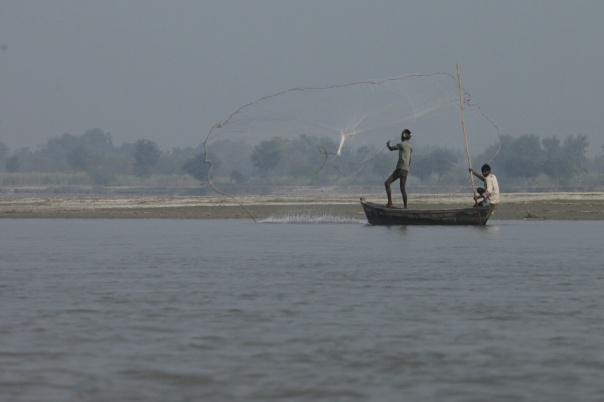
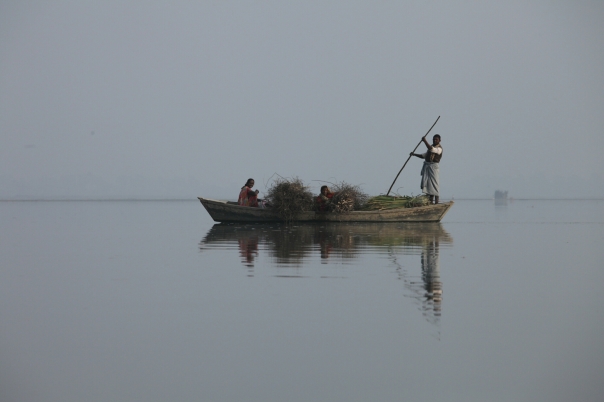
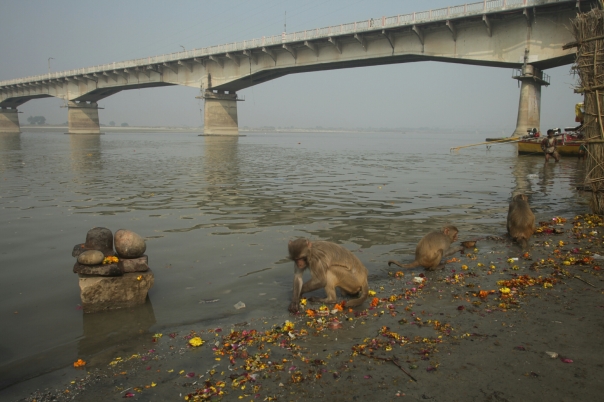
Almost two decades later, Malika’s husband and son took up the challenge of rowing down the Northern flank of the Ganga watershed as it emerges from the Himalayas in Eastern Uttarakhand. Theo and Zanskar rowed almost 2000 kilometres, for 75 days, from November 2014 to February 2015, along the Mahakali-Karnali-Ghaghra-Sarju-Ganga continuum, terminating their exploratory expedition in the delta of the Ganga in the Sundarbans. Malika joined them in the last leg of their voyage.

Do have a look at some images from their blog:
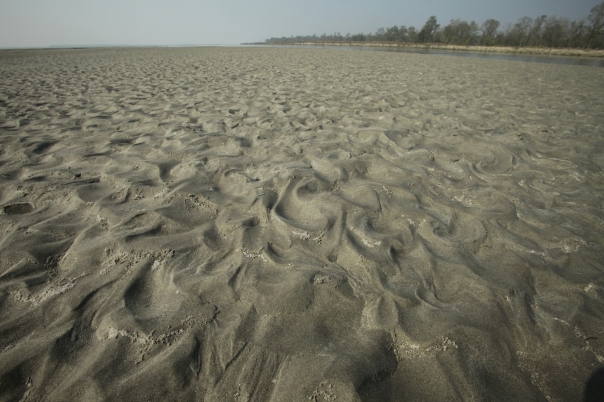
image

image

image

image

Much sanctimonious lip-service is paid by Indian governments, especially the one in office right now, to the rapidly deteriorating condition of the Ganga. Theo and Zanskar’s blog of their voyage is worth reading for anyone genuinely concerned about the state of not only the Ganga under the assault of so-called ‘development’, but indeed any major river, whose waters are being targeted for re-engineering into a destructively ambitious, man-made system of nationally interlinked waterways. It is time for metropolitan India to wake up to the enormous perils that lie in wait if ecological rashness continues to prevail among its policy elites:
https://nadisutra.wordpress.com/page/4/


Mesar Kautik (Mela)

Two beautiful village girls once went bathing in a mountain lake hidden by forests. One of them fell in love with a man who she met there and who took her up the mountain. The pandit at the temple spilled the beans to the villagers, who came up the slope looking for the missing girl. When they confronted the man who had taken the girl, wanting her back, the man told them that they could have her body back, though her spirit would remain with him. The villagers consented and had to face the dead body of the girl, who had been killed by the man. He appeared to them in the form of a wrathful god who cursed the village community that no more than one child would be born to each family. From that day onwards the villagers began offering a sacrificial goat at the mountain lake in order to appease the god. They began to commemorate the occasion    with a mela.

The lake is Mesar Kund, a few kilometres up the slope from where Malika, Theo, Zanskar and Ram live. They have helped the village community in restoring it. The village is Sarmoli and the community call themselves the Barpatiya. The mela to mark the occasion is called Mesar Kautik.

It happens tomorrow.


Thursday, 5 February 2015

Why isn't there an Indian green party ?

How/why, four decades after Chipko and Silent Valley, is there still not even a regional green party in India, let alone a national one? And how might someone like Gandhi think about this strange impasse, given the sheer gravity of the agro-ecological situation? After all, it is civilisation itself which is at peril.

Let us first handle one issue, the one about "compactness", which some argue accounts for green parties in countries like Germany. Skeptically considered, one would be led to ask whether all compact countries have green parties and no large, widespread country has one. The point is made by a contrast between Singapore (which still does not have a green party) and Brazil (which does for over 25 years now). India's story is of course more complex than each such extreme case. But my question still is, how come a Himalayan green party - linking issues from Chipko and Tehri to Teesta and Subansiri - has not come about in these last few decades? 

Could it have something to do with how politics has traditionally been framed in India? I think it would be fair to say that the Indian political imagination may be out of phase with modern ecological history and context. And this may have something to do with the fact that our political landscape has been all but lazily plagiarised from early 20th century Europe (without due upgradation or reconsideration in light of our own better knowledge of our past and present). Our political episteme itself is compromised in the process. India's liberals created a Congress modelled on the Whigs of Britain, the Communists modelled themselves after the Marxists there, and the Hindu communalists after their Fascist heroes abroad. I believe that mainstream Indian politics has stagnated after independence for all the reasons that haven't changed since Rajni Kothari's 'Poltics in India' (1970) appeared. The 'Congress System' has become even more decadent with the passage of time, the real steep fall coming rather rapidly after the pogrom against Sikhs in 1984. About the only slim and slender gain that might accrue in the public sphere from Modi's 2014 victory is the possibility of a proper indigenisation of the Indian political imagination - provided someone finds the courage and public intelligence to stand for Swaraaj. 

I told Arvind Kejriwal a year ago, when he was CM-1, that if he did intend to fight Lok Sabha, he should present the following alternatives to the people, keeping in view AAP's ideology of Swaraaj: "Vote for the assassins of Gandhi, the traitors of the Gandhi, or the followers of Gandhi". I was shocked when he said he could not do that! Even in this Delhi campaign he has not dared to do it. And without this extra moral courage, I do not believe the terms of politics will change from within the electoral scheme of things. More likely they will head Right, possibly even with Kejri at the helm! Let us not underestimate the power of the sheer momentum of two decades of consolidation of corporate feudalism in this country!

Likewise, in all our policy recommendations to AAP last year, we said that all economic policy henceforth should be made in an integrated manner with environmental policy, within a long-term horizon of 'Harit Swaraaj' (I am at work on a paper on it for the WSF and for a volume that Ashish is editing). I even suggested a 'Harit Swaraaj Sangh' (HSS), with its slogan of "Dharti Maata ki Jai!" to challenge the RSS slogan of "Bharat Maata". I believe that such an initiative will have wide resonance in many parts of the country - like J&K, HP, Uttarakhand, Jharkhand, Chhatisgarh, Odisha, Goa, Madhya Pradesh, Rajasthan, and possibly others. Land, water and forest struggles are taking place everywhere I have visited during the last 8 years. The time for electoral ecological politics has been here for sometime (at least since Medha first appeared on the horizon), but no one has dared to take the plunge. As Gandhiji said of Christianity, to succeed, it will have to be tried out. My feeling is that it has to be happen in one or two places, for a domino effect to be unleashed. This is a largely safety-first conservative country, where to try something new, most people want guaranteed success first!

The other point about a green agenda emerging from only a science/theory/education/literacy-based culture could also be doubted. If there can be a land/water/forest-based movement in so many parts of the country, then why not also a political party? I think the key link issue here is livelihood. More and more people and places are making the link between loss of habitat and loss of livelihood - with no equivalent compensation in terms of remunerative and dignified employment. (I am going tomorrow for a couple of talks to Allahabad, to speak at the inauguration of a 'Beej Yatra' and at a PUCL seminar on 'Tikaau Vikaas' - where these issues will be in the foreground.) 

Also pertinent is the question of money-based economies and the inflation that comes with them. This, I believe, will take more time. Money is a more abstract and complex matter to understand and even if every Macroeconomics text has to admit that inflation is a form of (usually upward) redistribution of (real) wealth and income, it is hardly understood as such by masses (or even political parties or folks in the media) in this country - though they so evidently feel the pinch of higher prices, esp in the cities. 

As far as education goes, there are regions of this country I have visited - in Odisha, Jharkhand, Chhatisgarh especially - where the level of 'habitat literacy' is incomparably higher than it is in educated, metropolitan India, or even in Germany. The cognitive awareness of Adivasi communities in so many places is still profound, where it has had some breathing space from the juggernaut still. (Think, for instance, of the Jarawas who saved themselves from the Tsunami by following the animals to the highlands, while Swedish tourists perished on the beaches of the Andamans. Or think of the adivasi elderly women to whom the drug and pharma companies go looking for herbs to patent. Why don't they go to MS Swaminadhan or Amartya Sen?) I find agrarian communities - especially the generation born before 1975 or so - also ecologically far more literate than downtown India. 

I believe strongly that Gandhi and Rabindranath have to brought to the centre of political-cultural-economic discourse in this country. If educated politicos in this country begin to heed their own ecological and cultural contexts rather than relying on a dated vision from the West, a lot would change. But McCaulay has had more of an impact on them than on the Babus, one would imagine!

Related to all this is also the fact that Indians - far more so than most cultures, and in a mode of colonial imitation, more thoroughly than Westerners - have reduced everything to politics. We are an over-politicised people. It has made us prisoners of the illusions spawned by that greatest of monsters of modernity - the modern State. This is the sort of thing that had been feared by men as otherwise divergent in their views as Gandhi, Rabindranath and Vivekananda. It is time we redressed this profound imbalance in our culture, return to realms of the spirit both individually and together, and forge new visions from compassion and community, freedom and creativity. Justice will follow.

Friday, 23 January 2015

The Impasse of Development: Some Questions and Answers

I visited the Indian Institute of Management, Ahmedabad on January 19-21, 2015. I gave two interrelated lectures on The Impasse of Globalized Development in India and The Way Out: Ecological Democracy. I copy below my responses to a set of questions sent to me by a student who attended the talks. The questions pertain to the ecology and political economy of development as it unfolds aggressively in India.

Dear Saritha,

Thanks for your questions and apologies for this delayed response. I got back to Delhi just yesterday.

My responses are in brown font below. Hope they answer your queries.

I am marking the mail to Prof. Ankur Sarin and his colleagues. Other students may have similar questions, in which case this mail could be forwarded to them.

Good wishes,
aseem


On 20 January 2015 at 00:01, Saritha Sudharmma Vishwanathan <sarithasv@iimahd.ernet.in> wrote:
Dear Professor,
I was the student that asked about agriculture can gain respect when it has become polluted due to unsustainable use (example Punjab).
I had the following questions from today's lecture:
1. Initially you narrate the discourse of development, how the word was coined; however is it not describing a dominant discourse? Do we not have other forms of development? like ecocentric form which you talked in the later half of the session. What are the other discourses around development during earlier or the same time period?


​Of course there are many other discourses of 'development'. And lots of interesting books on the topic. We discuss and critique the dominant discourse in our book simply because when all is said and done, and whenever a choice is to be made, it prevails over all the alternatives. I have answered your question at length in this article:


I will also ask you to have a good look at Gilbert Rist's excellent book 'A History of the Idea of Development', as well as the work of Korean economist Ha-Joon Chang. 


2. Occupational freedom: Kerala government is presently incentivizing youth to take up agriculture. In contrast, when I visited a village SIR near the outskirts of Ahmedabad last year, youth prefer leaving the village for better living and job prospects in town. We have two extremes in addition to village to village migration you mentioned in the class. What is your perspective of youth in India today from your travels?


​The motivations of youth vary a lot and my experience is not too dissimilar to yours. But one has to recognise the degree to which such motivations are influenced by state policies, state propaganda, the propaganda of the corporate media (working also thru peer pressure) etc. The reason why many state governments are having to incentivize agriculture is because the economics of small farming has been deliberately and systematically run down for three decades (see Chapter 6 of 'Churning the Earth' for a detailed analysis) to serve the interests of global agribusiness, apart from the routine neglect of things like irrigation. So, very bad policies have provided a real basis for the view which has now taken hold, and not just among rural youth, that "there is no money in farming." If so, how does the money return the moment large agribusinesses gain entry into agriculture? Global economics has quietly conspired with Indian caste/status prejudices to make farming unattractive. As I said, there is little hope unless this trend is reversed. And it is possible to do so with only a slightly more enlightened leadership than the one we have today.. 


3. Oil Imports will increase in the coming years. There is a shift towards solar and other renewable sources of energy as compared to earlier projections. Technology will play an essential role in terms of efficiency and sustainability in this aspect. Behavior also plays an important role. When you talk about ecological democracy ..you are talking about a paradigm shift in how we approach problems?


​Of course... Technology will continue to play a key role. The question is what kind ​of technology it will be and what will guide key technological choices. Will the short-term commercial calculus of energy corporations (working thru state policies) continue to drive such decisions? Or will long-term criteria of ecological sustainability enable us to make the choices, and if so, what publicly accountable institutional mechanisms will make this possible? If the past continues to repeat itself, I am afraid we are facing runaway climate change and all the downsides of peak oil etc. If business-as-usual is not allowed and the policy imagination is widened and deepened to allow other possibilities - which will necessarily mean that energy majors will take hits on their bottom lines - then there is a future. I suggested that ecological democracy is a political imperative to allow such rational public choices.


4. You also mentioned about decisions to be taken democratically. We have a constitution that talks about individual right when India can be argued to be living as a collective society. With collective rights - what happens to women, children? Is the collective full of vested interests or you are talking about a democratic collective? can this be possible? Will there be a devils' advocate and also voice for the future generation (future say 7th generation)?


​Your question is a very good one. But also difficult to address in the abstract, independent of a concrete social context of an actual community.​ It is true that in India the Constitution guarantees (mostly) individual rights. In this sense, the polity is oriented towards the individual citizen. But the dominant mode of social identity is still the community (the 'biradiri' in North India), the source of no end of conflict between the legal and the actual! (This is very, very different from the West, where a British PM could win three successive elections, while claiming that 'there is no such thing as society', a statement which would disqualify even a panchayat election candidate in India!) Despite all, I look upon community in India as an asset, from an ecological perspective, though I am fully aware that 'the community' can neither be fetishised nor glorified. Much actual work needs to be done in practical contexts to make community life somewhat less inequitable. The democratisation of the collective, as you put it, is surely in order. But before you democratise a collective you need an actual community! The State, for instance, cannot democratise a collective from the top, and out of thin air, as is the wish of many liberals. As my Facebook metaphor tries to say, the quiet workings of a corporate-dominated market has been rapidly eroding community life across the world, including India, especially in recent decades, because of the speed of digital technology. It has become hard to visualise how communities can be resurrected under such conditions. And yet, as our book outlines in Part II, there are some very instructive experiments unfolding around the country (and the world). It remains to be understood how in a culture like ours, communities continue to survive - if not thrive - despite such enormity of pressure on them from the State and the market.

Also, by no stretch do I mean to imply that collective rights must come at the expense of the individual. The two must go together, and for me, they do. The original meaning of the word 'individual' (from the European 12th century) is "that which cannot be divided." The individual, Aristotle writes in 'Ethics', can only flourish and come into his/her own if s/he has a community to live in/with. Modernity has failed to grasp this important point.

And yes, your point about 'the seventh generation' is an all too pertinent one. Institutional mechanisms can be devised, within the framework of an ecological democracy to adhere to Gandhi's principle of 'the last man'. One way of speaking about ecological democracy in an authentic, Indian way is as 'Harit Swaraaj'. I claim that it is not only necessary for our civilisational survival, it is infinitely more possible to achieve it than the market utopia of the neo-liberals, where everyone has a car and a condo on the beach. That is literally impossible!


5. Environment Regulation vs Attitudinal/Behavior change. Are you hopeful of attitudinal change towards energy conscious behavior, pro-enviromental behavior will happen in future?


​Attitudes in our time are formed by 'the Idiot Box'...consumers do not exist in a cultural vacuum. It is no longer parents or teachers who bring up children and young people. Corporations do. Their marketing divisions are spending billions to shape the minds and hearts and dreams (if not also the DNA!) of the young...so yes, a LOT of fundamental attitudinal changes are in order! But corporations will be the last to want to change all this...it will take radical public education.

As someone suggested in our discussion the other evening, it will take a series of mighty shocks to some of the world's metropolitan centres ​for a sustained attitudinal change which will take account of 'inconvenient truths'. 

But to know where to turn and what to do in such moments of grave crises as are staring at us from the future, we have to prepare the thinking for the road(s) ahead from now. So, hereon,  it is always going to be timely to speak about ecological democracy. A clear vision is needed.


6. The latest draft policy on innovation does touch upon promoting Indian craft. I need to check that but I am sure it also talks about smaller finances for promoting localized innovations.
Prof Anil Gupta in IIMA works on grassroot innovations and could provide more insight in this subject.


​Yes, indeed. I had a good look at his impressive 'Shodhyatra' exhibition on your campus day before yesterday...this is definitely the way forward. Have a look at the discussion on Malkha/DCYT and Kutambakkam in Part II of Churning the Earth.​


7. When I heard about Ecological democracy..it made me remember about the book Earth Democracy by Dr. Vandana Shiva.  How is Ecological Democracy different Earth Democracy and also from the concept of 'eco-centric development'?


​It is similar to Shiva's notion, insofar as I am familiar with it. But I suspect that there are some differences to do with what the concept of 'Harit Swaraaj' means. To me, democracy leaves the individual ​unchanged, confusing freedom with political liberty. This is not so with 'Swaraaj', whereby the individual is radically transformed through social action and spiritual self-realisation. The latter is key to Swaraaj, it is not so to democracy. 

CHURNING THE EARTH: THE MAKING OF GLOBAL INDIA

CHURNING THE EARTH was published (in Hardback) by Penguin in May, 2012. The paperback edition appeared in January 2014. The Hindi version (which is the translation of an abridged version) will be published by Rajkamal Prakashan later this year (in 2015).

The book's website has links to all the reviews in over two dozen journals, magazines and newspapers. It also has links to the book's Amazon and Facebook pages:

http://www.amazon.com/Churning-Earth-Making-Global-India/dp/0670086258/

https://www.facebook.com/churningtheearth